
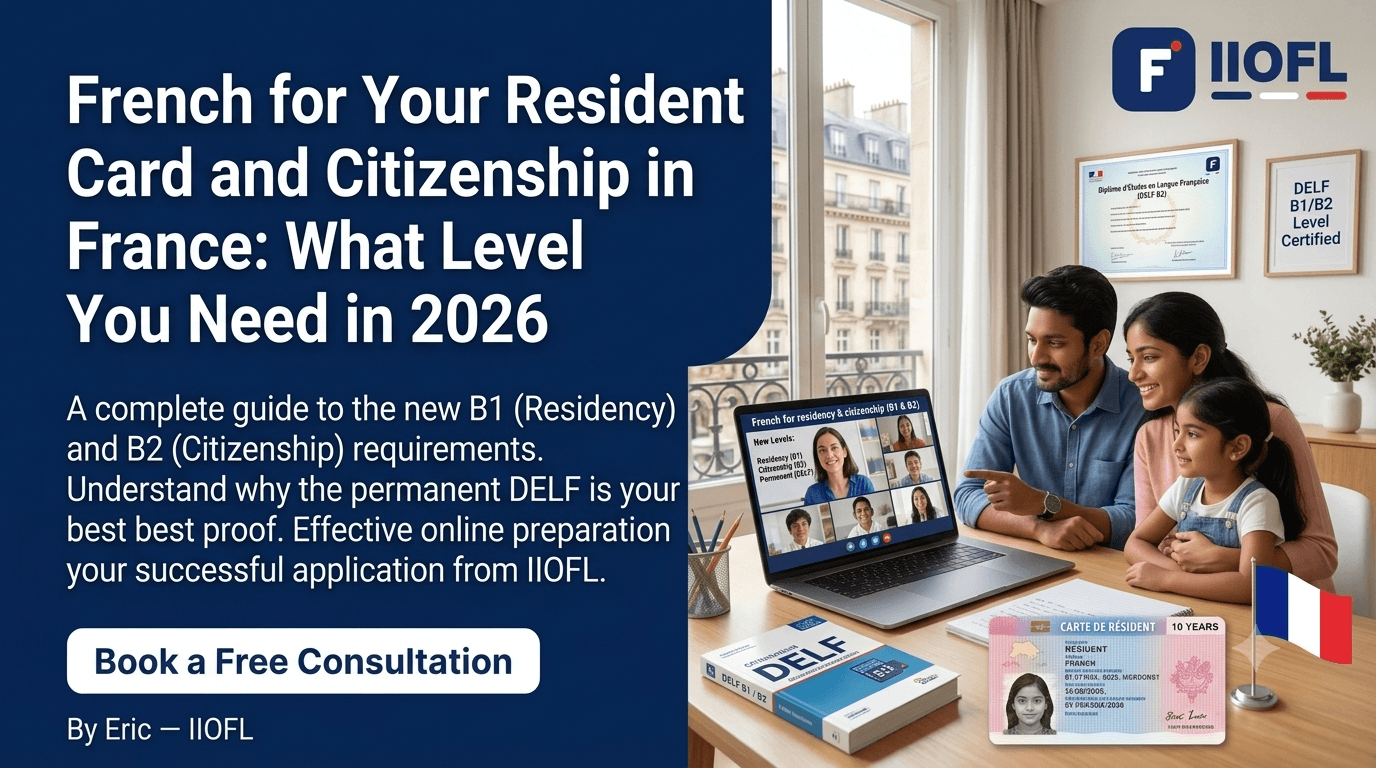

French for Your Resident Card and Citizenship in France: What Level You Need in 2026
For years, plenty of Indians built a whole life in France without ever sitting a French exam. You could manage at work in English, raise a family, renew your papers, and keep "learn French properly" on the someday list. That era is over.
Since the start of 2026, the language rules for staying in France long term have tightened, and they are stricter than most people expect. If you are Indian and living in France, or planning to be, this is one part of your file you cannot improvise at the last minute.
What the law actually asks for now
Three thresholds matter, and each sits at a different rung of the European scale, the A1 to C2 ladder you have probably already seen.
For the multi-year residence permit (carte de sejour pluriannuelle), you need to show an A2 level. For the ten-year resident card (carte de resident), the bar is now B1. For naturalisation, whether by decree or through marriage, you need B2. That last one used to be B1, so the requirement climbed a full level.
To put that in plain terms: A2 is basic everyday conversation. B1 is handling daily life on your own in French. B2 is real working fluency, the level where you can hold your ground in a fast conversation and read a contract without panic. Going from nothing to B2 is a genuine project, which is exactly why starting early matters.
Rules like these do get adjusted, and individual situations can have exceptions, so always confirm the current requirement for your exact case with your prefecture or on the official French administration sites. What I can tell you is where the bar sits today and how to clear it.
Why the DELF is the smart proof to aim for
You can certify your level with a few different exams, but they differ on one point that matters more than people realise: how long they stay valid. For a full breakdown of the differences, see DELF vs TEF vs TCF: Which French exam do you actually need?.
The TCF and the TEF are valid for about two years. Miss your window and you pay and sit the whole thing again. The DELF works differently. It is a diploma, not a test score, and it never expires. Pass your DELF B2 once and that B2 is yours for life, whether you apply for citizenship next year or in ten years.
For someone building a life in stages, first the resident card, later the nationality, that permanence is worth a great deal. You climb the ladder once and keep every rung.
Where most learners actually start
Here is something I see constantly. People assume that because they live in France, they must already be at some comfortable intermediate level. Then we run a placement test and the real picture appears. Living in a country is not the same as studying its language. Plenty of people who have been in France for years still sit around A2, because they picked up survival French by ear and never built the grammar underneath it.
That is completely normal. It just means the honest starting point is often lower than people hope, and the road to B2 is longer than a quick fix. A true beginner aiming at B2 for citizenship should plan for the full A1 to B2 journey, real months of steady work, not a few weeks of cramming. For a realistic sense of how long that journey takes, the short answer is around nine months at a steady pace of three sessions a week.
How to get there without losing a year
A few habits separate the people who reach B2 from the people who stall at A2 forever.
Study live, with a teacher and a small group, not alone with an app. Speaking is half the exam, and you do not build speaking by tapping a screen. You build it by talking to someone who corrects you on the spot.
Prepare for the specific exam, not just French in general. The DELF has its own format, its own speaking task, its own listening traps. Knowing the format is a big part of passing it. Our DELF preparation page has the full breakdown of what each level involves.
And begin before you need it. The painful version of this story is discovering the B2 requirement three months before your naturalisation appointment. The calm version is having your DELF already sitting in a drawer when the moment comes.
Not sure where you stand?
If you are unsure of your current level, sort that out first, because everything else depends on it. We run a free placement test that tells you honestly where you sit on the A1 to B2 ladder and what it would take to reach your target.
Take the free placement test, or message us on WhatsApp and tell us your goal, the resident card, citizenship, or simply speaking real French at last. We will tell you the level you need and the fastest honest way to get there.
Related reading: DELF vs TEF vs TCF: Which exam do you need? · How long does it take to reach B2?